
If you carry a Citizens wind-only policy on a Florida Keys home, flood insurance is becoming a required part of the package, and the final phase-in lands on January 1, 2027. That date closes a multi-year rollout that started in 2024, and it means nearly every Keys wind policy with Citizens will need flood coverage attached, regardless of your flood zone, even on properties the maps call moderate risk. For a county where flood insurance already averages roughly $2,000 a year, this is a change every buyer and homeowner should plan for now, not discover at renewal.
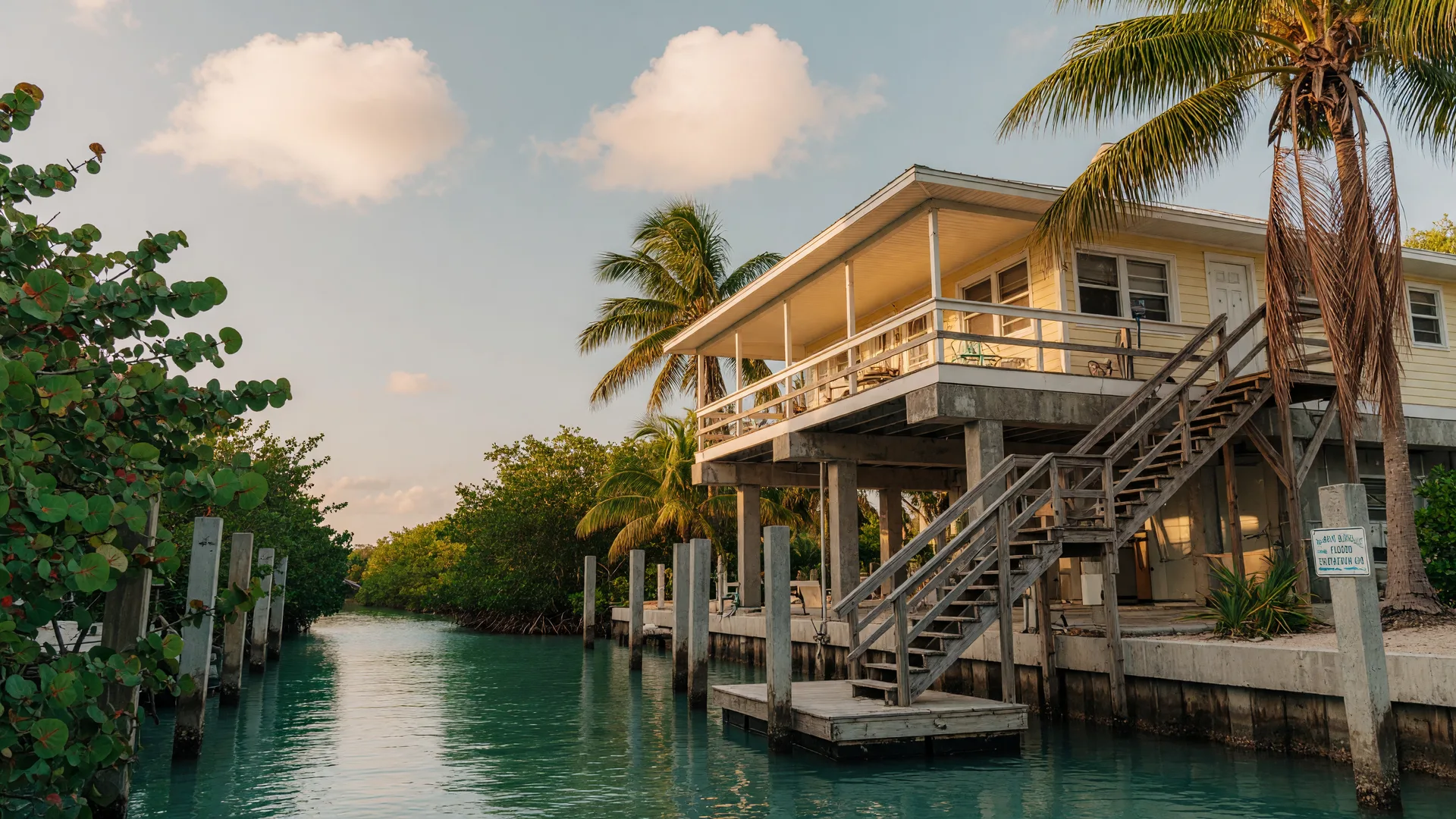
This guide explains what the Citizens flood requirement is, who it touches, what flood insurance costs in the Keys in 2026, and the steps you can take to lower your premium before the deadline. Whether you are buying a home in Key Largo, Islamorada, Marathon, or Key West, this affects your insurance budget and your mortgage qualification.
What Is the Citizens Flood Insurance Requirement?
Citizens Property Insurance is the state-backed insurer of last resort in Florida, and in Monroe County it carries the bulk of wind policies because most private carriers still exclude the Keys. Under Florida law, Citizens personal residential policies that include wind coverage must also carry flood insurance. The requirement phases in by dwelling replacement cost, which is the value Citizens uses to price your wind policy, not your purchase price and not your tax assessment.
The goal is simple: to stop the scenario where a hurricane produces both wind damage and a storm surge flood, and the homeowner has wind coverage but no flood coverage for the bigger loss. When a wind policy pays out for a roof but the structure's flooding is uninsured, both the homeowner and the state-backed insurer end up in a worse position.
For the full background on how flood coverage works in the Keys, including FEMA's Risk Rating 2.0 pricing model, see the complete flood insurance guide.
The Phase-In Schedule: Why January 1, 2027 Matters
The requirement did not arrive all at once. It has rolled out in stages tied to dwelling replacement cost, which gave higher-value policyholders the longest runway:
- January 1, 2024: policyholders with dwelling replacement costs of $600,000 or more became required to carry flood coverage.
- January 1, 2025: the threshold dropped to $500,000 and above.
- January 1, 2026: the threshold dropped again to $400,000 and above.
- January 1, 2027: the final phase, when all remaining Citizens personal residential wind policies must maintain flood coverage, regardless of dwelling value.
That last step is the one that matters to most Keys homeowners. Even a modest Keys home, and even one in a moderate-risk zone, will need flood coverage if its wind policy is with Citizens. The requirement applies across flood zones, which is worth repeating: Citizens is not waiting for FEMA to call your property high risk. It is requiring flood coverage on the wind policy it writes, period.
Who This Affects in the Florida Keys
This reaches more Keys households than you might expect, because of how the market is structured here:
- Most Keys wind policies are with Citizens. Private wind carriers have returned to much of Florida in recent years, but most still exclude Monroe County. If your wind coverage is a Citizens wind-only policy, the flood requirement applies to you.
- It covers second homes and investment properties too. The requirement applies to Citizens personal residential policies, which includes second homes. Financing a second home or a vacation home in the Keys does not exempt you from this rule.
- Condo owners are typically covered differently. If you own a condo unit, flood coverage for the building and its common areas usually sits in the association's master policy, which the HOA carries, not in your individual wind picture. Unit owners still typically need a contents-only flood policy. Your lender reviews the master policy as part of condo financing approval.
- Buyers should assume flood coverage is part of the deal. Federally backed mortgages already require flood insurance on properties in high-risk Special Flood Hazard Areas (the AE and VE zones), which covers most of the Keys. The new wrinkle is that even moderate-risk properties with a Citizens wind policy now need flood coverage too, so you cannot plan around skipping it.
The result: for most Keys buyers, flood insurance is no longer a discretionary line item. It is as close to a fixed cost as wind insurance itself.
What Flood Insurance Costs in the Florida Keys in 2026
Monroe County already has the highest average flood insurance costs in Florida. Based on current NFIP policy data, the county holds roughly 36,500 active policies with an average premium of about $2,000 a year, which works out to around $72 million in total annual premiums and sits well above the statewide average. The county-level average is a starting point, and your actual number depends on your property's elevation, replacement cost, and distance to water under FEMA's Risk Rating 2.0 pricing.
Here is the practical range buyers see across the Keys in 2026:
- Elevated single-family home in a lower-risk Zone X: $700 to $1,500 a year.
- Standard elevated home in Zone AE (canal or bay side): $2,000 to $4,000 a year.
- Coastal property in Zone VE (oceanfront or open bay): $4,000 to $8,000 a year.
- High-value coastal properties: $10,000 to $25,000 a year.
For the full breakdown by property type, see the cost section of the flood insurance guide. And because wind coverage still runs $4,000 to $12,000 a year for a typical Keys single-family home, the total insurance picture, wind plus flood plus hazard, usually lands between $15,000 and $25,000 a year. The wind insurance cost guide walks through that side of the budget.
Flood Zones in the Keys: AE, VE, and X
Flood zone designations come from FEMA's Flood Insurance Rate Maps, and they tell you how much of the requirement and the premium you should expect:
- Zone AE: a Special Flood Hazard Area with a 1 percent annual chance of flooding and a determined Base Flood Elevation. This is the most common high-risk designation across the Keys, and it is where most canal and bay-side homes sit.
- Zone VE: a coastal velocity zone on the open waterfront where waves and velocity add to the flood hazard. Oceanfront and open-bay properties in VE zones carry the highest risk and the highest premiums.
- Zone X: a moderate-to-low-risk area outside the 100-year floodplain. Flood insurance has not been federally required here, which is exactly why the Citizens requirement matters: it closes that gap for wind policyholders.
Because the requirement now reaches into Zone X, the flood zone alone no longer tells you whether you need coverage. The question is which insurer writes your wind policy. If the answer is Citizens, the answer to the flood question is yes.
How the Requirement Affects Your Mortgage
Flood insurance has always been a qualification factor for Keys buyers, and the Citizens phase-in makes it a more certain one. Here is what it means for financing:
- Flood premiums are usually escrowed. Like wind insurance, your flood premium is typically collected with your monthly payment and paid by your lender. That makes it part of your housing payment, not a separate annual bill you can budget for later.
- It counts against your debt-to-income ratio. A $2,000 annual flood premium adds about $165 a month to your housing payment before principal and interest. On a waterfront property with a $6,000 to $8,000 flood premium, that figure is $500 to $650 a month, and it reduces the home price you qualify for.
- Lenders require proof of coverage before closing. No Keys loan closes without flood coverage in force, whether the property is in a federally mandated zone or not. The Citizens requirement just makes it likelier that coverage is expected on any given property.
- It applies across loan programs. The cost math is the same for conventional and FHA loans, and it is part of the expense picture on jumbo loans for higher-value waterfront homes. On an investment property, flood is a direct expense in the rental cash flow math, including on DSCR loans, where higher expenses mean more rental income is needed to cover the payment.
Getting the real flood premium before you make an offer is the difference between a budget that works and a payment that surprises you at closing. That is why I model the actual wind and flood premiums into every pre-approval I run for Keys buyers.
How to Lower Your Flood Premium Before the Deadline
Flood coverage is now effectively unavoidable on a Citizens wind policy, but you have real control over the price. Here are the steps that actually move the number:
- Submit an accurate elevation certificate. Under Risk Rating 2.0, FEMA prices from property-level data including your first-floor elevation, and it starts from a geolocation-based estimate. A licensed surveyor in Monroe County typically charges $400 to $1,000 for a certificate, and if your lowest floor is higher than FEMA assumed, the certificate can lower your premium for years. It is one of the highest-value documents a Keys buyer can get.
- Elevate mechanicals above the lowest floor. HVAC equipment, electrical panels, and water heaters that sit above the flood line are treated as less at risk, which improves your rating.
- Use engineered flood openings. Enclosed areas below the Base Flood Elevation need flood openings so water can pass through, which reduces the pressure and the rating risk.
- Consider a LOMA if the map is wrong. If your natural ground elevation is genuinely above the Base Flood Elevation but the map shows you in a high-risk zone, a Letter of Map Amendment can remove the property from the Special Flood Hazard Area, which can reduce required coverage and premium. Not every property qualifies, and the survey data has to support it.
- Compare private flood options. Private flood insurers can price well on elevated, well-maintained properties, sometimes below NFIP. The trade-off is that private policies can be non-renewed after a loss, while NFIP offers guaranteed renewal. For the full comparison, see private flood insurance vs. NFIP.
One caution on timing: these steps take time. Surveys and LOMAs are not same-week fixes, and if you are closing on a home this fall, you want to start the flood process in your due diligence period, not a week before closing. The same logic applies to wind coverage, so see the wind mitigation credits guide for the inspection that lowers that side of the bill.
What Keys Buyers and Homeowners Should Do Now
The January 1, 2027 deadline is about two and a half months away, which is enough time to plan but not enough time to delay. Here is the practical checklist:
- If you are buying: ask the seller for the current flood policy and premium, request the elevation certificate if one exists, and get a flood quote during due diligence. Build the number into your offer before you commit.
- If you are renewing a Citizens wind policy: expect flood coverage to be required or added at your next renewal, and budget for it. If your premium jumped recently, ask your agent whether a current elevation certificate would lower it.
- If you are financing: tell your loan officer the real flood and wind premiums early. They change how much home you can comfortably afford, and modeling them correctly is exactly what a good pre-approval does.
- If you are comparing a condo: review the association's master policy and confirm a contents-only flood policy is in your budget.
For the broader insurance picture and how all the pieces fit together, the homeowners insurance guide in the Learning Center is a good place to start, and the October 2026 market update has the current rate and price picture across the Keys.
Frequently Asked Questions
Do I need flood insurance with a Citizens policy in Florida?
How much does flood insurance cost in the Florida Keys in 2026?
Does the Citizens flood requirement apply in Zone X?
Is flood insurance required for a mortgage in the Florida Keys?
How can I lower my flood insurance premium in the Florida Keys?
Ready to Run the Real Numbers?
Flood insurance is becoming a fixed cost of Florida Keys homeownership, and it should not be a surprise at the closing table. I model the actual wind, flood, and hazard premiums into every pre-approval I run, so the number you qualify for reflects the true cost of the property you are looking at. If you are considering a home anywhere in the Keys, let us run your real numbers together, including the coverage picture for the specific property.
Written by Austin Edwards, NMLS #2639747, Ocean Blue Lending
Published October 16, 2026
Flood Insurance Guide · Private Flood vs. NFIP · Wind Insurance Costs · Blog · Learning Center