
Wind mitigation credits are the single most effective way to lower your wind insurance premium in the Florida Keys, and most homeowners never take advantage of them. A documented wind mitigation inspection can cut your wind premium by 20 to 40 percent, which in the Keys often means $2,000 to $5,000 or more in annual savings. For a waterfront home, the savings can be even larger.
This guide explains how wind mitigation credits work in 2026, what the new OIR-B1-1802 inspection form means for your property, which features earn the biggest discounts, and how the My Safe Florida Home program can help pay for the upgrades that qualify. If you are buying a home in the Keys, this is information you want before you make an offer, not after you close.
What Are Wind Mitigation Credits?
Wind mitigation credits are premium discounts that Florida insurers are required by law to offer for properties with documented wind-resistant features. Florida Statute Section 627.0629 requires every insurer writing residential wind coverage to provide premium credits for specific mitigation features, and the discount must be applied when the features are documented on a uniform inspection form.
The logic is simple: a home built or retrofitted to resist hurricane-force winds is less likely to suffer a catastrophic wind claim, so the insurer's risk is lower, and your premium should reflect that. The credits are not a favor from the insurance company. They are a legal requirement, and the only reason many Keys homeowners do not receive them is that they have never had the inspection done.
In the Florida Keys, where wind-only premiums routinely run $4,000 to $12,000 a year for single-family homes and $12,000 to $22,000 for waterfront and older properties, a 20 to 40 percent credit is a meaningful part of the total cost of ownership. It is also a factor in your mortgage qualification, because wind insurance is part of your total housing payment and your debt-to-income ratio. See the wind insurance guide for the full picture of how wind coverage affects Keys mortgages.
The New OIR-B1-1802 Form: What Changed in 2026
Wind mitigation credits are documented on the Uniform Mitigation Verification Inspection Form, known as OIR-B1-1802. In 2026, this form got its first major rewrite in more than a decade, and it changes what inspectors document and how credits are calculated.
Here is what you need to know:
- The revised form (Rev. 04/26) is required for all new inspections performed on or after April 1, 2026. It replaces the previous Rev. 01/12 form, which had been in use since 2012.
- The update is based on the 2024 Residential Wind-Loss Mitigation Study, which re-examined which building features actually reduce wind losses in Florida's high-velocity hurricane zones.
- New items on the form include the design wind speed region, roof slope, and FORTIFIED designations, along with performance-based options for roof-to-wall attachments that give inspectors more accurate ways to document how the roof is connected to the walls.
- Documentation requirements are stricter. The new form requires more photos and product documentation for impact windows, roof coverings, and roof-to-wall connections, which means the inspection is more thorough and the credits are better supported.
- An inspection remains valid for up to five years. If you had a Rev. 01/12 inspection completed within five years before April 1, 2026, most insurers still accept it until it expires. After that, you will need a new inspection on the revised form.
What this means for Keys homeowners: if your wind mitigation inspection is older than a few years, or if you have never had one, now is the time to schedule a new inspection on the revised form. The updated form captures more features than the old one, which can mean larger credits for homes that were already well built.
Which Features Earn the Biggest Credits?
The inspection documents specific features of the property, and each feature contributes to the total credit. These are the features that matter most in the Keys:
- Impact-rated glazing. Impact-resistant windows, doors, and skylights that meet Miami-Dade County product approval standards are one of the largest single credits on the form. If the home has hurricane shutters instead, they must be documented as opening protection.
- Roof shape. Hip roofs receive larger credits than gable roofs because they are more aerodynamic in high winds. This is a structural feature you cannot change easily, but it is worth knowing how it affects your premium.
- Roof deck attachment. How the roof sheathing is fastened to the framing, and the spacing of the fasteners, is a major factor. Nailed versus stapled decking and fastener spacing are documented on the form.
- Secondary water resistance. A self-adhering membrane installed under the roof covering prevents water intrusion if the primary roof covering is damaged. This is one of the most cost-effective upgrades you can make.
- Roof-to-wall connections. Hurricane straps, clips, and tie-downs that secure the roof structure to the walls are documented, and the new form offers performance-based options for how they are evaluated.
- Opening protection. Every exterior opening, including windows, doors, and garage doors, must be protected by impact-rated glass or approved shutters to qualify for the full credit.
An older home without impact windows or a modern roof deck can still qualify for meaningful credits after installing opening protection or a secondary water resistance membrane. The improvements you make reduce your premium for the life of the policy, and in the Keys the payback period is often short because the premiums are so high.
How Much Can You Save in the Keys?
Wind mitigation credits typically reduce wind premiums by 20 to 40 percent, and the dollar amount depends on the property's value and its current premium. Here is what that looks like for typical Keys properties in 2026:
- Typical single-family home with a $7,000 to $10,000 wind-only premium: a 25 to 35 percent credit saves roughly $1,750 to $3,500 per year.
- Waterfront or older home with a $12,000 to $22,000 premium: the same percentage credit saves $3,000 to $7,000 or more per year.
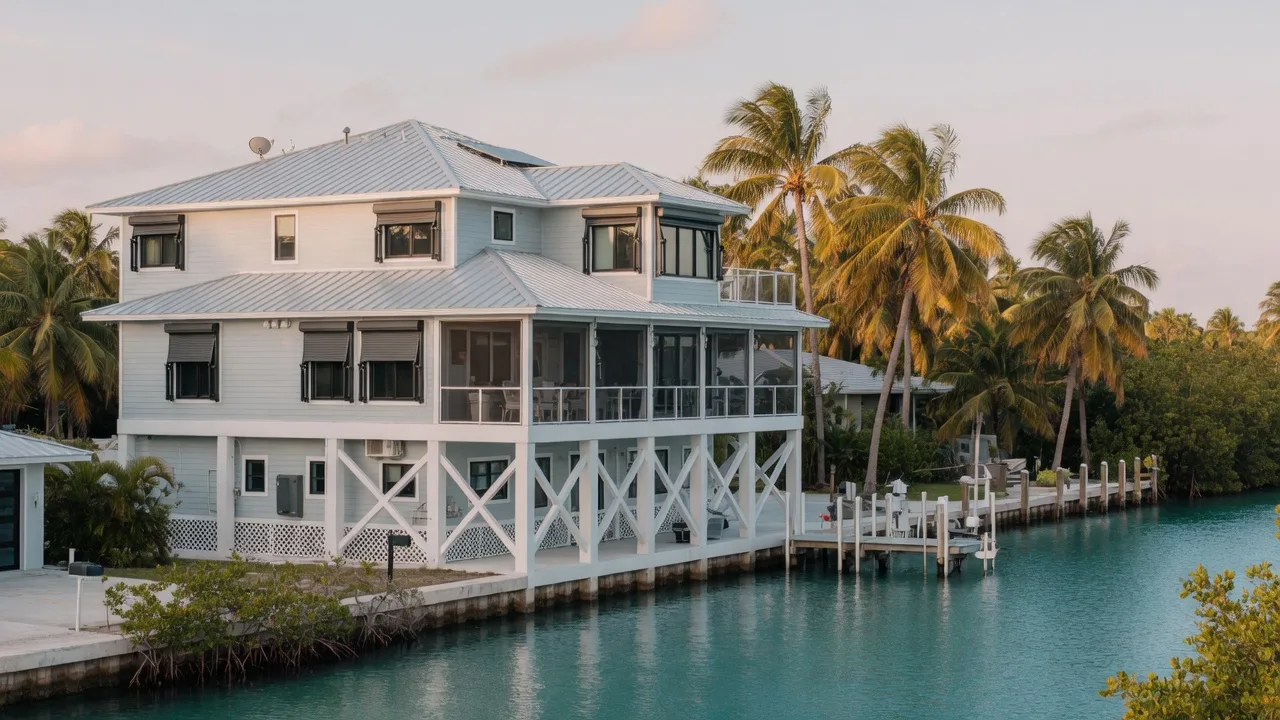
- Newer elevated construction with impact windows, a hip roof, and a modern roof deck: often qualifies for the maximum credits, which is one reason these homes carry the lowest wind premiums in the Keys.
The inspection itself typically costs $100 to $250, so the payback is measured in weeks, not years. If you are buying a home, ask the seller for the existing wind mitigation inspection report before you make an offer. If one does not exist, budget for the inspection during your due diligence period and factor the expected savings into your offer.
For buyers financing a home, remember that wind insurance is part of your total housing payment. A $3,000 annual credit is $250 a month of buying power. That can be the difference between qualifying for the home you want and settling for a smaller one. A lender who understands Keys insurance costs will model the mitigation-adjusted premium in your pre-approval. See the conventional loan and jumbo loan guides for how insurance fits into qualification.
My Safe Florida Home: Free Inspections and Grants
If you are a homeowner in the Keys, the My Safe Florida Home program can help you get the inspection and the upgrades at a fraction of the cost. The program, administered by the Florida Department of Financial Services, reopened to new applicants on August 4, 2025, with $280 million for the 2025-26 fiscal year.
Here is how it works:
- Free wind mitigation inspection. The program provides a state-certified wind mitigation inspection at no cost to the homeowner, which is the same inspection that documents your credits.
- Matching grants up to $10,000. The program offers a matching grant for hurricane-hardening upgrades including impact windows and doors, hurricane shutters, roof upgrades, and wind-rated garage doors.
- Low-income homeowners can receive up to $10,000 with no match required. Moderate-income homeowners receive a 2:1 match, meaning the program pays two dollars for every one dollar the homeowner contributes.
- Applicants are prioritized by factors including low income and seniors, and the program is funded on a first-come, first-served basis, so applying early matters.
Homeowners who complete the program save an average of about $1,000 per year on their premiums, and in the Keys the savings are typically higher because the premiums are higher. If you are planning upgrades anyway, the grant can cover a meaningful share of the cost, and the resulting credits reduce your premium for the life of the policy.
Wind Mitigation and the 2026 Rate Environment
Wind mitigation credits matter even more in 2026 because of where the Keys insurance market stands. Citizens Property Insurance, which carries the vast majority of Monroe County wind policies, approved rate filings that took effect at spring 2026 renewals: Monroe County homeowners with more than 1,000 policies received an average 11.3 percent reduction, and more than 8,000 wind-only policies in Monroe County received a reduction or no increase. A separate Citizens multiperil filing effective July 1, 2026 cut wind-only policyholder rates an average 5.5 percent statewide.
That is real relief, but Monroe County remains the most expensive county in Florida for wind coverage, with proposed average premiums around $6,800 to $7,000 a year. And while Citizens has shrunk from roughly 1.4 million policies to about 278,000 as private carriers have returned to Florida, most of the new private carriers still exclude Monroe County, so most Keys wind policies remain with Citizens. The combination of rate relief and mitigation credits is the most realistic path to a lower premium for most Keys homeowners.
For the broader picture of how wind insurance works in the Keys, including Citizens wind-only policies and the 50 Percent Rule, see the wind insurance guide. For how flood coverage fits alongside it, see the flood insurance guide.
What to Ask Before Buying a Keys Home
If you are shopping for a home in the Florida Keys, add these questions to your due diligence list:
- Is there a current wind mitigation inspection report on file, and was it completed on the revised OIR-B1-1802 form?
- What is the current annual wind-only premium, and what credits are already being applied?
- Are the windows impact-rated or protected by approved shutters?
- What year was the roof installed, and does it have a secondary water resistance membrane?
- Are hurricane straps or clips installed at the roof-to-wall connections?
- If the home is in Key Largo, Islamorada, Marathon, or Key West, does the premium reflect the property's actual mitigation features?
Getting these answers during the inspection period means no surprises at the closing table, and it gives you a negotiating lever if the seller has never had the inspection done.
Frequently Asked Questions
What is a wind mitigation inspection in Florida?
How much can wind mitigation credits save on Florida Keys insurance?
What is the new OIR-B1-1802 wind mitigation form?
Does My Safe Florida Home pay for wind mitigation improvements?
How long is a wind mitigation inspection valid in Florida?
Ready to Put the Savings to Work?
Wind mitigation credits are one of the few things in the Keys that can lower your cost of ownership without changing the home you buy. Whether you are shopping for a new home or own one already, the inspection is inexpensive, the credits are required by law, and the savings compound every year.
I work with Keys buyers and homeowners every day to structure financing that accounts for the full cost of Keys homeownership, including wind, flood, and hazard insurance. If you are considering a home in the Florida Keys, let us run the numbers together, including the mitigation-adjusted premium, so you know your real payment before you make an offer.
Written by Austin Edwards, NMLS #2639747, Ocean Blue Lending
Published September 9, 2026
Wind Insurance Guide · Flood Insurance Guide · Homeowners Insurance Guide · Learning Center