
A waterfront home in the Florida Keys is one of the most desirable purchases in American real estate, but the purchase price is only the beginning. If you are looking at canal-front, bayfront, or open-water properties from Key Largo down to Key West, you need to understand the full cost picture before you make an offer.
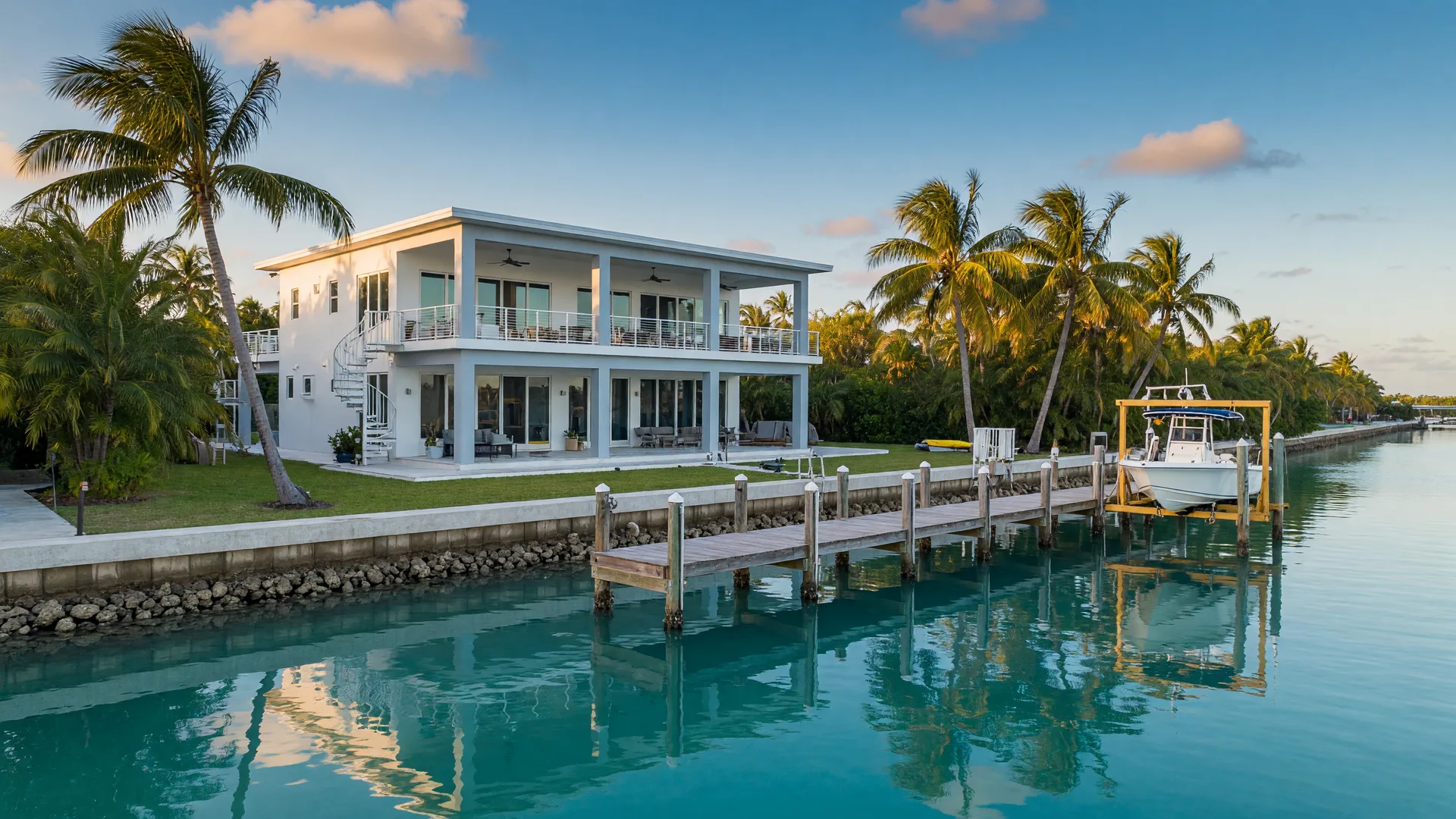
This guide breaks down every cost that comes with a waterfront Keys property: the purchase premium you will pay for water access, the annual insurance burden (flood, wind, and hazard), the maintenance costs for seawalls, docks, and boat lifts, and the less obvious expenses that can catch out-of-area buyers off guard.
The Waterfront Premium: What You Pay for Water Access
Waterfront homes in the Florida Keys command a significant premium over non-waterfront properties. The premium depends on the type of water access and the specific location.
In early 2025, open-water homes in the Keys sold at an average of approximately $3.25 million compared to roughly $1.22 million for non-waterfront single-family homes. That is a premium of roughly 167 percent for direct open-water access. Across Florida more broadly, waterfront properties typically command a 25 to 40 percent premium above comparable non-waterfront homes, though in the Keys that range can stretch from 60 percent to well over 100 percent for prime oceanfront locations.
Here is how the tiers break down by water type:
- Oceanfront and open-water properties command the highest prices. In the Keys, these are properties with direct, unobstructed access to the Atlantic Ocean or Florida Bay. Per-square-foot pricing typically runs $700 to $1,400 or more, representing a 40 to 80 percent premium over canal-front comparables.
- Bayfront properties sit on Florida Bay or its protected basins. These fall between oceanfront and canal-front in price, offering excellent water access and views at a somewhat lower premium than direct oceanfront.
- Canal-front homes are the most accessible tier of Keys waterfront living. In Key Largo, canal-front homes typically start around $1 million, while non-waterfront single-family homes start in the $500,000s. For many buyers, canal-front represents the best value for direct water access, with the ability to dock a boat and enjoy the Keys lifestyle without the oceanfront price tag.
For specific communities, the ranges look like this:
- Key Largo median sold price across all homes was $875,000 in early 2025. Non-waterfront single-family homes start in the $500,000s. Canal-front homes begin around $1 million. Bayfront and oceanfront properties range from $1.5 million to over $10 million for prime estates.
- Islamorada oceanfront listings on Windley Key and along the Atlantic side start near $900,000 for lots and smaller properties, with established oceanfront homes ranging significantly higher. The sportfishing capital of the world commands a premium for deep-water access.
- Marathon open-water waterfront homes average around $2.75 million. Canal-front homes offer more accessible entry points, and the central location appeals to buyers who want easy access to both ends of the Keys.
- Key West median home price sits at about $1.135 million, with waterfront and oceanfront properties pushing well into the multi-million dollar range. Old Town waterfront properties are among the most expensive per square foot in the state.
Insurance: The Largest Recurring Cost of Waterfront Ownership
Insurance is the single biggest line item that mainland buyers underestimate. A waterfront Keys property needs three layers of coverage, and the combined annual cost is substantial.
Wind and hazard insurance in Monroe County is among the highest in Florida. For a waterfront property valued at $600,000 to $1 million, expect $8,000 to $20,000 per year. For a $2 million-plus oceanfront home, wind insurance alone can run $35,000 to $50,000 or more annually. Some Keys properties can only be insured through Citizens, Florida's insurer of last resort. Starting in 2025, Citizens requires flood insurance on any structure with a dwelling replacement cost of $500,000 or more, which covers virtually every waterfront home in the Keys.
Flood insurance is mandatory for any waterfront property financed with a mortgage, because nearly all Keys waterfront sits in high-risk FEMA flood zones (VE for oceanfront and open bay, AE for canal-front and protected bay properties). Annual flood insurance costs range from $2,000 to $5,000 for a well-elevated canal-front home on pilings, up to $10,000 to $25,000 for oceanfront properties in Zone VE. New elevated construction built to current code typically falls in the $4,000 to $5,000 range for flood alone.
Combined wind, flood, and hazard insurance for a Keys waterfront home typically totals $15,000 to $25,000 per year for a standard elevated canal-front property. For oceanfront homes, combined premiums can exceed $40,000 to $60,000 annually. That is $1,250 to $5,000 per month that needs to be budgeted into your housing costs from the start.
This is the single most important number to run before you make an offer. I have seen buyers fall in love with a property, negotiate a fair purchase price, and then discover at the loan application stage that the insurance cost pushes their monthly payment beyond what they qualify for. Always get insurance quotes during your due diligence period, not after you are under contract.
Seawalls: An Expensive Necessity
If the property has shoreline, it almost certainly has a seawall. And seawalls in the Keys are expensive to build, maintain, and repair.
New seawall construction in the Florida Keys runs about $1,000 per linear foot for vinyl seawalls including flatwork. For a typical residential lot with 50 to 80 feet of shoreline, that means $50,000 to $80,000 for a new seawall. For larger lots or those requiring concrete or sheet-pile construction, costs can reach $175,000 or more.
Annual maintenance runs $500 to $2,000 per year for cleaning, inspection, and minor repairs. Emergency repairs after a storm or a vessel impact can easily exceed $50,000. And here is the critical point: standard homeowners insurance policies explicitly exclude seawall damage. If a storm surge or a boat damages your seawall, you are paying for the repair out of pocket.
When you are evaluating a waterfront property, have the seawall inspected during your due diligence period just as you would the roof or the HVAC system. A seawall that is leaning, cracked, or showing signs of erosion behind it may need replacement within a few years, which is a six-figure expense most buyers do not budget for.
Insurance companies are increasingly looking at seawall condition when underwriting coastal policies. A deteriorating seawall can affect your ability to get coverage or can increase your premium.
Docks and Boat Lifts: The Cost of Deep-Water Access
One of the main reasons people buy waterfront in the Keys is for boat access. But docks and boat lifts come with their own price tags.
Dock construction averages $15,000 to $30,000 for a standard residential dock in Florida, though costs can go significantly higher in the Keys depending on water depth, bottom conditions, and permitting complexity. Pilings alone run $300 to $700 each, and a dock may need a dozen or more depending on length. A boathouse adds $10,000 to $40,000 to the project. Permits from the Florida Department of Environmental Protection and the Army Corps of Engineers are required, and permitting timelines can take months.
Boat lift installation costs vary by the size of the vessel: a jet ski or PWC lift runs $3,000 to $8,000, a small boat lift for vessels up to 10,000 pounds runs $8,000 to $18,000, a mid-size lift for 10,000 to 20,000 pounds runs $18,000 to $30,000, and a large lift for 20,000 to 40,000 pounds runs $30,000 to $50,000. Heavy-duty sportfishing boat lifts can exceed $100,000.
When you are shopping waterfront properties, ask whether the dock and boat lift convey with the property, and get a marine surveyor's inspection on the dock structure. A dock with rotted pilings or corrosion issues can be a five-figure repair.
Elevation and Foundation Considerations
Most waterfront Keys homes are elevated on pilings to meet flood elevation requirements. This is a good thing for flood insurance costs but comes with maintenance considerations.
Pile foundations need periodic inspection for corrosion, marine borer damage, and structural integrity. In saltwater environments, even treated wood piles eventually deteriorate, and concrete piles can develop spalling from salt exposure. Replacement of a few failed piles is expensive, and full foundation replacement is a major capital project.
Elevation certificates are critical documents for any elevated Keys home. They show the height of the lowest floor relative to the Base Flood Elevation, which directly determines your flood insurance premium. If a property does not have an elevation certificate on file, budget $300 to $600 to have one prepared. A low elevation relative to BFE can mean thousands of dollars in additional annual flood insurance cost.
The Army Corps of Engineers has estimated that county-wide home elevation and floodproofing projects across Monroe County would cost $2.6 billion. That gives you a sense of how significant the elevation picture is across the Keys. For individual buyers, the key takeaway is this: newer, properly elevated construction on sound piles costs less to insure than older homes that sit closer to base flood elevation.
ROGO Permits and What They Mean for Waterfront Buyers
Monroe County's Rate of Growth Ordinance, known as ROGO, is something every Keys buyer needs to understand. ROGO limits the number of new residential building permits issued each year. This means the supply of buildable lots in the Keys is effectively capped, and every home that exists today represents a transferable ROGO allocation.
For waterfront buyers, the practical effect is significant: if a waterfront home is demolished, the ROGO permit cannot simply be replaced. This makes existing waterfront structures uniquely valuable and means that renovating and repairing an existing home is almost always preferable financially to demolishing and rebuilding. It also means the land under a waterfront home has inherent scarcity value that mainland markets do not have.
ROGO is one reason waterfront prices in the Keys have historically appreciated over the long term. The supply of waterfront properties cannot meaningfully increase, while demand from buyers across the country and around the world continues to grow.
How Waterfront Costs Affect Your Mortgage and Financing
Every waterfront cost we have discussed feeds directly into your mortgage qualification. Here is how:
Loan limits. The conforming loan limit for Monroe County in 2026 is $990,150. Most waterfront properties exceed this threshold, which means you will likely need a jumbo loan. Jumbo loans typically require larger down payments (20 to 30 percent for waterfront properties), higher credit scores, and larger cash reserves after closing. Jumbo loan requirements in the Florida Keys are a topic worth understanding before you start shopping waterfront.
Insurance affects your debt-to-income ratio. Your total annual insurance premium is divided by 12 and added to your monthly housing payment. If your combined wind, flood, and hazard insurance is $24,000 per year, that is $2,000 per month added to your qualifying payment. A buyer who qualifies for a $6,000 monthly payment at 4 percent on a conventional loan might see their effective buying power reduced by $100,000 or more when insurance costs are factored in.
Cash reserves. Lenders typically require two to twelve months of PITI (principal, interest, taxes, and insurance) in cash reserves after closing, especially for jumbo loans and second homes. For a waterfront property with high insurance costs, the reserve requirement can be substantial. Make sure you understand the reserve requirement for your specific loan program before you write an offer.
Vacation rental potential. If you are buying a waterfront property as a second home or investment property, waterfront properties in the Upper Keys command 30 to 50 percent higher nightly rental rates compared to non-waterfront homes. For DSCR loans, higher rental income can help offset the higher insurance and maintenance costs. Cap rates on waterfront vacation rentals in the Keys typically range from 3 to 5 percent for open-water luxury estates and 4 to 7 percent for waterfront homes with pools, compared to 4 to 7 percent for condos with rental programs.
For conventional loans, FHA loans, VA loans, and jumbo loans, insurance costs are a direct factor in the underwriting decision. Every lender will verify that adequate insurance coverage is in place before closing, and the monthly cost feeds into your debt-to-income ratio.
The Total Monthly Cost of a Waterfront Keys Home
Let us put the numbers together for a typical scenario. For a $1.5 million canal-front home in Key Largo or Islamorada with a 20 percent down payment and a 30-year jumbo loan at current rates:
- Principal and interest: Approximately $5,500 to $6,500 per month depending on rate
- Property taxes: Approximately $1,000 to $1,400 per month
- Wind and hazard insurance: $800 to $1,500 per month
- Flood insurance: $250 to $500 per month
- Seawall and dock maintenance (annualized): $100 to $200 per month
- Total monthly housing cost: $7,650 to $10,100 per month
Compare that to a non-waterfront home in the same area at $600,000, where the monthly cost might be $3,500 to $5,000. The difference is primarily driven by the larger loan amount and substantially higher insurance costs. That is a real difference that needs to work with your income and budget.
This is not meant to discourage anyone from buying a waterfront home. It is meant to set realistic expectations so you do not fall in love with a property and then discover the numbers do not work.
Questions to Ask Before You Make an Offer on Waterfront
- What is the current annual wind insurance premium, and has it been stable or increasing?
- What is the current annual flood insurance premium, and what flood zone is the property in?
- Is there an elevation certificate on file? What is the lowest floor elevation relative to BFE?
- What is the condition of the seawall? When was it last inspected or repaired?
- Does the dock convey with the property? When was it built, and what condition are the pilings in?
- Does the boat lift convey? What is its weight capacity and condition?
- What is the property's ROGO allocation status?
- Are there any proposed FEMA map changes that could affect this property's flood zone?
- If the home is in a condo or HOA, what are the master insurance policy costs and how are they allocated?
Frequently Asked Questions
How much more does a waterfront home cost in the Florida Keys compared to non-waterfront?
How much does insurance cost for a waterfront home in the Florida Keys?
Is a jumbo loan required for a waterfront home in the Florida Keys?
How much does it cost to maintain a seawall in the Florida Keys?
Are waterfront homes in the Florida Keys good investments for vacation rentals?
Ready to Start Your Waterfront Search?
A waterfront home in the Florida Keys is a significant financial commitment, but with the right preparation and a lender who understands Keys coastal financing, it is an achievable goal. The key is knowing the full cost picture from the start so there are no surprises at the closing table.
I help Keys buyers every day structure financing for waterfront properties, from canal-front fixer-uppers to oceanfront luxury estates. I can help you understand how insurance costs, jumbo loan requirements, and cash reserve needs affect your buying power before you start looking at properties.
Written by Austin Edwards, NMLS #2639747, Ocean Blue Lending
Published August 24, 2026
Jumbo Loans Guide · Flood Insurance Guide · Wind Insurance Guide · Learning Center