
If you are looking to buy property in the Florida Keys, one of the first questions your lender will ask is: how do you plan to use this home? The answer matters more than you might think. Mortgage rates, down payment requirements, and lender guidelines all shift depending on whether you are buying a primary residence, a second home, or an investment property. And the differences are especially meaningful in the Keys, where most buyers are purchasing something other than a primary home.
This guide breaks down exactly how financing differs across the three property types, what lenders look for, and how to choose the right mortgage structure for your situation.
Why the Distinction Matters in the Keys
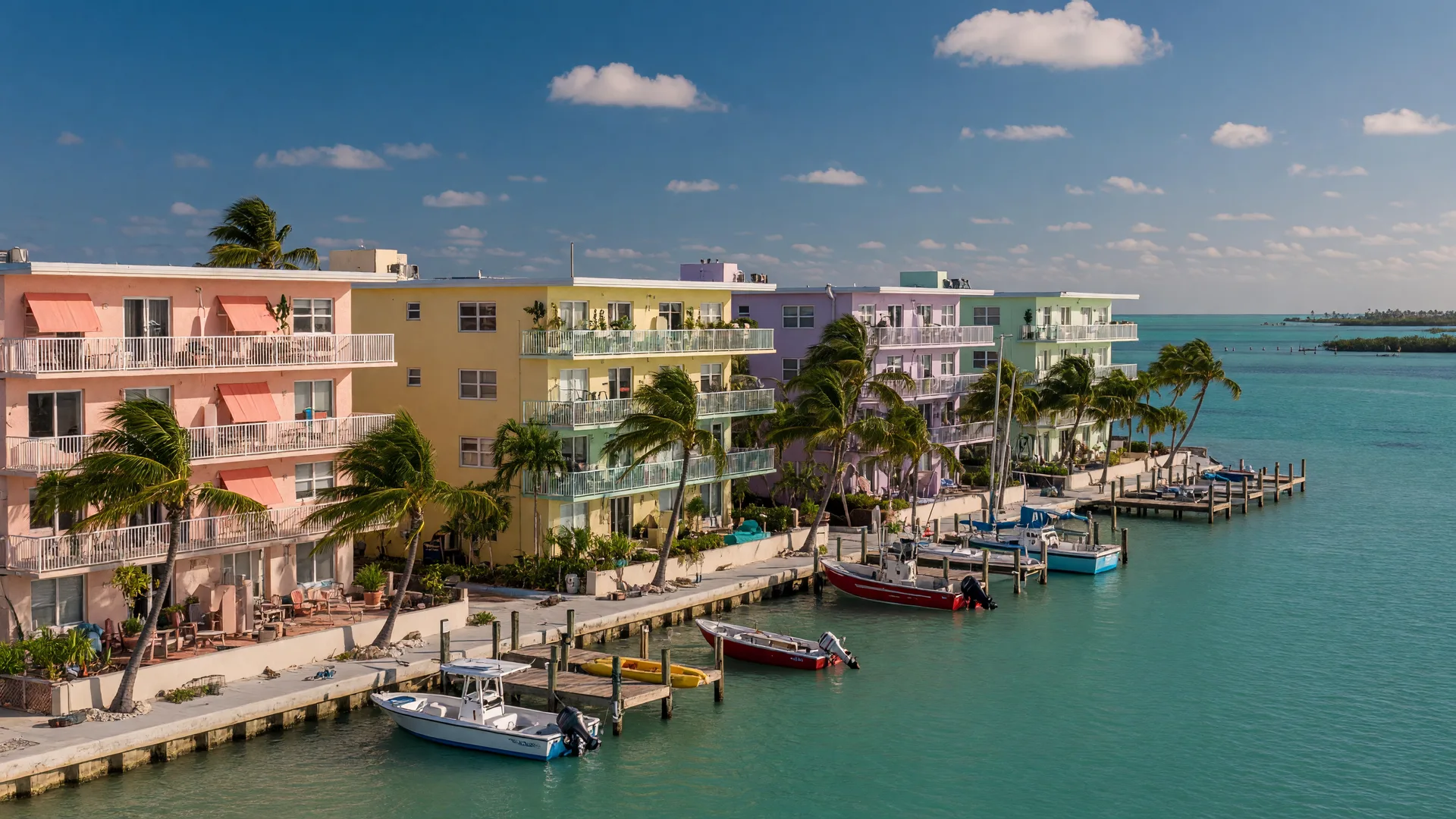
In most parts of the country, the majority of home purchases are primary residences. The Florida Keys are different. Monroe County has one of the highest concentrations of second homes and investment properties in the country. Many of the iconic stilt homes on the water, the Conch houses in Old Town Key West, and the condominiums along the Overseas Highway are owned by people who live elsewhere most of the year.
For lenders, the use of the property is one of the most important risk factors in determining loan terms. A primary residence is the lowest risk because people are most likely to keep paying the mortgage on the home they live in. A second home is moderate risk. An investment property is the highest risk, because if financial pressure hits, the rental property is usually the first one the owner stops paying on.
That risk hierarchy shows up in every part of the loan: rates, down payments, credit score requirements, and reserve requirements. Understanding where your purchase fits is the first step toward getting the right financing.
Primary Residence: The Lowest Bar to Entry
If you are moving to the Florida Keys and making a home your primary residence, you have the most financing options available. This is the property type lenders are most comfortable with, and it comes with the best terms.
Down Payment Requirements
- Conventional loans: 3 to 5 percent minimum down payment. If you put less than 20 percent down, you will pay private mortgage insurance (PMI) until you reach 20 percent equity.
- FHA loans: 3.5 percent minimum down payment with a 580 credit score. FHA loans require an upfront mortgage insurance premium (1.75 percent of the loan amount) plus annual MIP.
- VA loans: Zero down payment for eligible veterans and active-duty service members. No PMI requirement.
- USDA loans: Zero down payment in eligible rural areas. Note that most of the Florida Keys do not qualify for USDA because the area is designated as too high-income for the program.
Rates and Credit
Primary residence loans carry the lowest rates of the three property types. As of August 2026, 30-year fixed rates for a primary residence in the Keys are running approximately 6.50 to 6.70 percent for well-qualified borrowers. Minimum credit scores start around 620 for conventional loans and 580 for FHA. Lenders typically want to see a debt-to-income ratio of 45 percent or lower, with some flexibility up to 50 percent for strong borrowers.
The Monroe County Advantage
Monroe County is the only county in Florida with a high-cost area designation from the Federal Housing Finance Agency. In 2026, the conforming loan limit for a one-unit property here is $990,150 versus $832,750 everywhere else in Florida. This means more Keys homes can be financed with conventional loans at standard rates instead of jumbo loans, which typically carry higher rates and require larger down payments.
Homestead Exemption
One financial benefit exclusive to primary residences in Florida: the homestead exemption. If you establish your primary residence in the Keys, you can claim up to $50,000 off the assessed value of your home for property tax purposes. On a $900,000 home in Monroe County, that saves roughly $500 to $700 per year in property taxes. The homestead exemption also caps annual assessed value increases at 3 percent, which keeps your property taxes predictable even as market values rise.
Second Home: The Keys' Most Common Purchase Type
Second homes are the backbone of the Florida Keys real estate market. Many Keys communities, from Key Largo and Islamorada to Marathon and Key West, have neighborhoods where the majority of homes are second homes occupied part-time by people who live in colder states the rest of the year.
For lenders, a second home is a home that you intend to occupy for part of the year but is not your primary residence. It is not a rental property. You may rent it out occasionally, but it cannot be your primary source of rental income, and you must have exclusive control over its use.
Fannie Mae and Freddie Mac Second Home Rules
To qualify as a second home under conventional financing guidelines, the property must meet several requirements:
- The property must be located at least 50 miles from your primary residence (most lenders apply the standard 100-mile Fannie Mae guideline). For Keys buyers from the mainland, this is usually easy to satisfy.
- The property must be suitable for year-round occupancy. It must have full kitchen, bathroom, and sleeping facilities.
- You must have exclusive control over the property. Timeshares and fractional ownership properties do not qualify.
- The property cannot be subject to rental management agreements or pooling arrangements that limit your personal use.
- The property cannot be advertised as a short-term rental or listed on platforms like Airbnb or Vrbo during the time you are not occupying it (though occasional renting is acceptable under Fannie Mae guidelines as long as you retain control).
Down Payment and Rate Premiums
Second home loans require a minimum 10 percent down payment for conventional financing, though many lenders prefer 15 to 20 percent, especially in higher-value markets like the Keys. Rates run approximately 0.25 to 0.75 percent higher than primary residence rates. As of August 2026, second home 30-year fixed rates for well-qualified borrowers are averaging around 6.50 to 7.50 percent, depending on credit profile and loan amount.
Credit score requirements are also stricter. Most lenders want a minimum 680 FICO for second home loans, and borrowers below 700 may face rate add-ons. Lenders typically require 2 to 6 months of PITI reserves (principal, interest, taxes, and insurance) in liquid assets after closing.
For a deeper look at jumbo financing for higher-value second homes, see the Jumbo Loans in the Florida Keys guide.
Second Home Insurance Costs
If your Keys property is a second home, expect higher insurance costs than a primary residence. Under FEMA's Risk Rating 2.0, the annual increase cap for flood insurance on second homes is 25 percent versus 18 percent for primary residences. Wind and hazard insurance premiums are generally the same as for primary homes, since those rates are based on the property itself, not the owner's occupancy status. But the total package of hazard, wind, and flood insurance for a single-family second home in the Keys still runs $13,000 to $22,000 per year, and you will need to prepay the first year at closing.
For condos purchased as second homes, the HOA's master policy typically covers the building envelope, so individual insurance costs are significantly lower. See the Second Home Loans guide and the Condo Financing guide for more detail.
Investment Property: Financing for Rental Income
If you are buying a Florida Keys property primarily to generate rental income rather than for your own use, lenders classify it as an investment property. This is the most expensive property type to finance, but it also offers the most flexibility in how you use the property. You are not required to live in it at all, and the lender will evaluate the property based on its income potential, not your personal occupancy.
Down Payment and Rates
Investment property loans require a minimum 15 to 25 percent down payment for conventional financing. Single-family investment properties can go as low as 15 percent down with strong credit. Two- to four-unit investment properties typically require 25 percent down. Rates are approximately 0.50 to 1.50 percent higher than primary residence rates. As of August 2026, 30-year fixed rates for investment properties in the Keys are running approximately 7.00 to 8.25 percent.
Reserve Requirements
Lenders require 3 to 6 months of PITI reserves (principal, interest, taxes, and insurance) in liquid assets after closing for investment properties. If you already own other financed properties, the reserve requirement grows. Under Fannie Mae guidelines, borrowers with 5 to 10 financed properties need six months of reserves on each property. This is one area where Keys investment property buyers are often surprised: the cash required to close includes not just the down payment and closing costs but also substantial reserves held in your bank account after closing.
Using Rental Income to Qualify
One advantage of investment property financing is that lenders can use projected or actual rental income to help you qualify for the loan. For conventional loans, lenders typically use 75 percent of the market rent from the appraisal (the appraiser deducts 25 percent for vacancy and management costs) as qualifying rental income. This can offset the higher monthly payment of the investment property loan. For DSCR loans, the property's rental income is the primary qualification factor rather than your personal income.
Short-Term Rental Considerations
If you plan to use the property as a vacation rental (short-term rentals of less than 30 days), be aware that Monroe County and many individual Keys municipalities have their own regulations. Some communities restrict short-term rentals, and some condo associations prohibit them entirely. Before you buy an investment property in the Keys with the intention of running it as a vacation rental, verify the local regulations and the HOA rules for that specific property.
For properties where short-term rentals are permitted and the income potential is strong, DSCR loans are worth exploring. These loans base qualification solely on the property's debt service coverage ratio (rental income divided by the mortgage payment), so they do not require you to document personal income. This makes them especially useful for self-employed borrowers, real estate investors with multiple properties, and buyers whose income does not show up neatly on a W-2. DSCR loans typically require 20 to 25 percent down and carry rates in the 7.50 to 9.00 percent range as of August 2026.
Key Differences at a Glance
PrimarySecondInvestment
Min. down payment3-5%10%15-25%
Rate premiumBaseline+0.25-0.75%+0.50-1.50%
Min. credit score580-620680680-720
Reserves required2 months2-6 months3-6 months
Homestead exemptionYesNoNo
PMI possible?YesNoNo
Rental income qualifies?NoNoYes
Owner occupancy requiredYesPart-timeNo
How Loan Programs Compare Across Property Types
Conventional Loans
Available for all three property types with the down payment and rate differences outlined above. Fannie Mae and Freddie Mac have separate eligibility matrices for each property type, with second homes and investment properties subject to higher loan-level price adjustments (LLPAs). These adjustments add to your rate or closing costs and are based on your credit score and loan-to-value ratio.
FHA Loans
Primary residences only. FHA does not finance second homes or investment properties. If you are buying a primary residence in the Keys with a low down payment, FHA is an option, but the loan limits in Monroe County are $704,900 for a single-family home in 2026, which may be too low for many Keys properties.
VA Loans
Primary residences only for no-down-payment financing. However, eligible veterans can use their VA entitlement for second home purchases if the property is occupied part of the year, but the rules are stricter and the funding fee changes. For investment properties, VA financing is not available. VA loans also have no maximum loan amount, which is useful for higher-priced Keys homes.
Jumbo Loans
Available for all three property types. Jumbo loans exceed the conforming loan limit ($990,150 in Monroe County for 2026). For second homes and investment properties, jumbo loans typically require 20 to 30 percent down. Jumbo rates are higher than conforming rates across all occupancy types, and the premium for second homes and investment properties is larger in the jumbo space.
DSCR Loans
Investment properties and some second homes, but not primary residences. DSCR loans are designed for borrowers who want to qualify based on the property's income rather than their personal income. These are especially popular in the Keys for vacation rental properties. Down payments typically start at 20 to 25 percent, and rates run higher than conventional investment property loans. See the DSCR Loans for Vacation Rentals guide for a deeper look.
Case Study: Three Buyers, Three Approaches
Let me walk through three real scenarios to show how these differences play out in practice.
Scenario 1: The Relocating Buyer (Primary Residence)
Sarah is moving from Atlanta to Marathon for a remote work opportunity. She is buying a $750,000 single-family home with 10 percent down ($75,000). Her conventional loan is $675,000, well within the Monroe County conforming limit. Her 30-year fixed rate is 6.50 percent. She qualifies for the homestead exemption, saving roughly $500 per year in property taxes. Her total cash to close, including closing costs and insurance prepaids, is approximately $115,000.
Scenario 2: The Snowbird (Second Home)
Mike and Linda live in Chicago but want a condo in Key West for winters. They are buying a $700,000 condo with 20 percent down ($140,000). Because it is a second home, their rate is 7.25 percent, about 0.75 percent higher than a primary residence rate. They need 6 months of reserves, which means keeping roughly $30,000 in liquid assets after closing. Because it is a condo, their insurance prepaids are lower (only the HO-6 policy, since the HOA carries the master policy). Their total cash to close is approximately $160,000, plus the reserve requirement.
Scenario 3: The Investor (Investment Property)
David lives in Miami and wants to buy a $900,000 single-family home in Islamorada to use as a vacation rental. He is putting 25 percent down ($225,000). His rate is 7.75 percent, and he needs 6 months of PITI reserves, or roughly $45,000 in liquid assets after closing. He uses projected rental income (75 percent of the appraiser's market rent estimate of $6,000 per month, or $4,500 per month) to help qualify. His total cash to close, including reserves, is approximately $300,000. He can also explore a DSCR loan if he wants to qualify without documenting his personal income.
Common Mistakes Keys Buyers Make
Here are the most frequent errors I see when buyers classify their property incorrectly or misunderstand the financing differences:
- Classifying a rental as a second home: If you plan to rent the property for significant periods or list it on Airbnb, you cannot call it a second home on your mortgage application. This is occupancy fraud. Lenders verify occupancy through property inspections, utility records, and tax returns. The consequences include loan acceleration, foreclosure, and legal liability.
- Underestimating reserve requirements: Many buyers calculate their cash to close based on down payment plus closing costs and forget about the reserve requirement. For investment properties and second homes, the reserve requirement can add $20,000 to $50,000 or more to the cash you need to have on hand after closing.
- Ignoring insurance costs in the qualification: Keys insurance costs are so high that they can push your debt-to-income ratio over the limit even when the principal and interest payment alone looks fine. Lenders use the full PITI payment (including estimated hazard, wind, and flood insurance) to qualify you. Get an insurance quote early so you know the full monthly cost.
- Assuming conforming loan limits apply: The $990,150 Monroe County conforming limit is generous, but many Keys properties still exceed it, especially waterfront homes in Key West and Islamorada. If you are shopping above the limit, plan for jumbo loan terms from the start.
- Not considering the 50-mile or 100-mile rule: For second home classification, the property must be a reasonable distance from your primary residence. If you already live in Florida and are buying a Keys property that is close to your primary home, talk to your lender about whether it qualifies as a second home or needs to be classified as an investment property.
Tips for Choosing the Right Financing Approach
1. Be honest with your lender about how you plan to use the property. The loan program and terms you qualify for depend entirely on accurate classification. Do not try to fit an investment property into a second home box to get a lower rate. It will not work, and the consequences are serious.
2. Get pre-approved before you start shopping. The down payment and reserve requirements are different enough across property types that the same property at the same price could require $50,000 more in cash as a second home than as a primary residence. Know your numbers before you look at homes.
3. Factor insurance into every calculation. In the Keys, insurance is not an afterthought. It is often the single largest variable in your monthly payment and your closing costs. Get a real insurance quote for the specific property type (condo vs. single-family) before you commit to a purchase price.
4. If you are buying multiple properties, plan your financing order. Conventional financing becomes more expensive after you have financed four or more properties. There are also limits on how many Fannie Mae or Freddie Mac loans one borrower can have. If you plan to build a Keys portfolio over time, talk to a lender about the best sequence and structure.
5. Consider the tax implications. The homestead exemption, mortgage interest deduction, depreciation, and capital gains treatment all differ between primary residences, second homes, and investment properties. The mortgage decision and the tax decision are connected. Talk to a CPA or tax professional familiar with Florida Keys real estate.
6. Work with a lender who understands all three categories. Some lenders only do primary residence loans. Some specialize in investment properties. You want a lender who can show you the options across all three categories and help you choose the right one for your situation. That is how I work with every Keys buyer.
Getting Started With Your Keys Purchase
Whether you are moving to the Keys full-time, buying a vacation home to escape the mainland winters, or investing in a property that will generate rental income, the right financing starts with understanding how your property use affects your loan options. The Keys market is unique, and the financing solutions are just as unique.
I work with buyers across all three categories every day. Let us talk through your specific situation and find the right loan structure for your Keys property, whether that is a primary residence in Marathon, a second home in Key Largo, or an investment property in Key West.
Written by Austin Edwards, NMLS #2639747, Ocean Blue Lending
Published August 17, 2026
Second Home Loans · Investment Property Loans · DSCR Loans Guide · Jumbo Loans Guide · Back to Blog
Frequently Asked Questions
What is the minimum down payment for a second home in the Florida Keys?
Can I use rental income to qualify for a mortgage on a second home in the Keys?
What are the reserve requirements for a second home versus an investment property in the Keys?
Is a second home or an investment property cheaper to finance in the Florida Keys?
Can I use a DSCR loan for a second home in the Florida Keys?
Ready to Talk About Your Keys Purchase?
The Florida Keys market is unlike any other in Florida. Whether you are looking for a primary residence, a vacation getaway, or an income-producing investment property, the right financing starts with an honest conversation about how you plan to use the home.
I have helped buyers across all three categories find the right loan for their situation. Let us start the conversation and figure out what works for you.