
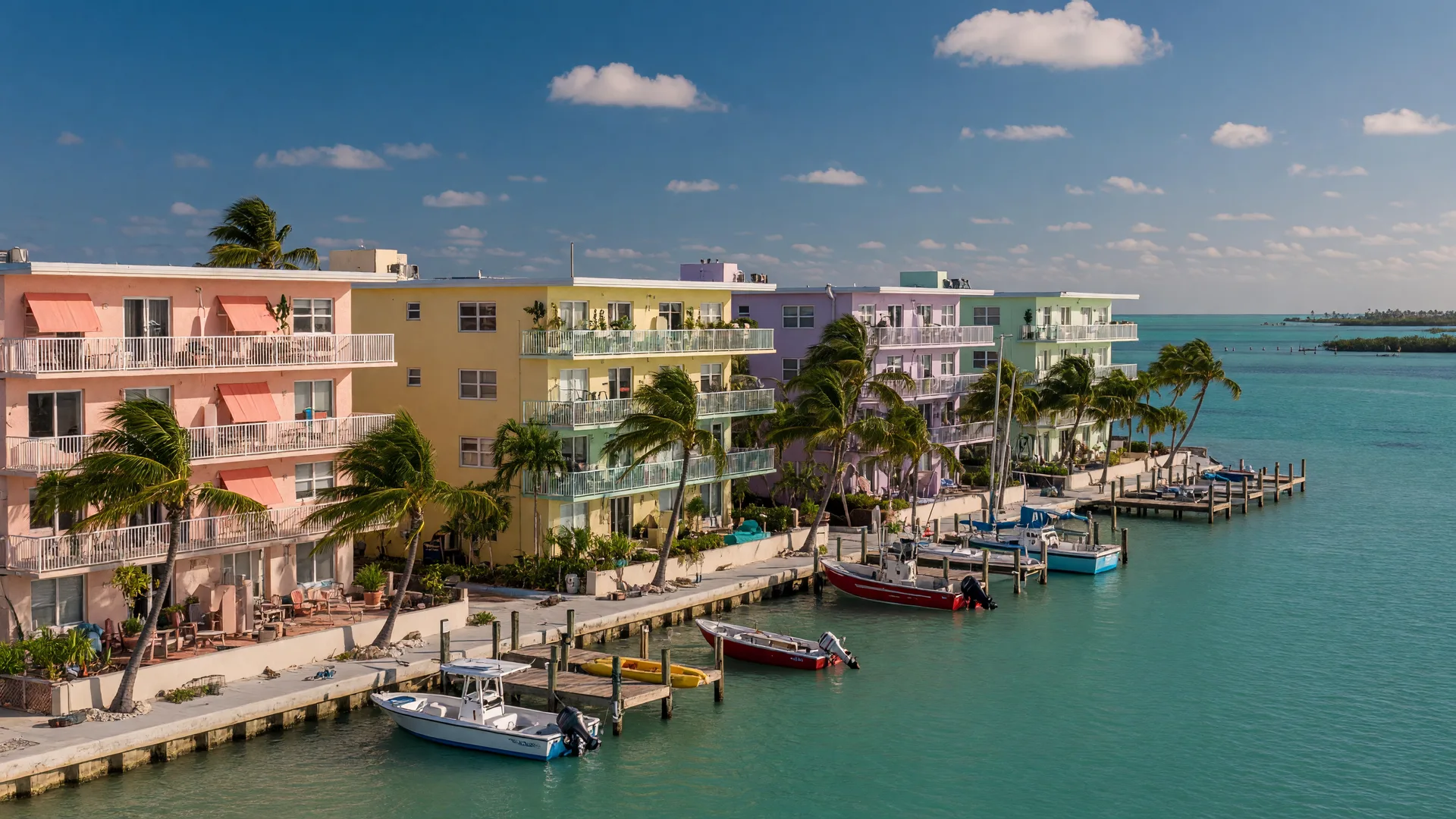
Condos are the most common housing type in the Florida Keys. From Key Largo to Key West, the islands are full of waterfront condominium complexes, and many buyers start their Keys home search looking at condos. But financing a condo in the Keys is different from financing a single-family home. The condo project itself needs to pass lender review, and the rules changed significantly after the Surfside collapse in 2021.
This guide covers everything Keys condo buyers need to know in 2026: how condo project approval works, what Florida's new structural requirements mean for buyers, how insurance costs factor in, and what questions to ask before you make an offer.
Why Condo Financing Is Different From Single-Family Financing
When you buy a single-family home, the lender evaluates your finances, the property's condition, and the property's value. That is the whole picture. When you buy a condo, the lender evaluates those things plus the financial health, insurance coverage, and legal standing of the entire condominium association. The unit itself is only one piece of the puzzle.
The reason is simple: as a condo owner, you share financial responsibility for the whole building, the common areas, the roof, the pool, the parking structure, and any deferred maintenance. If the association has underfunded reserves or inadequate insurance, that is a risk for the lender because it is a risk for you.
The Monroe County Advantage: Higher Conforming Loan Limits
Monroe County is the only county in Florida with a high-cost area designation from the Federal Housing Finance Agency. In 2026, that means the conforming loan limit for a one-unit property in the Keys is $990,150. Every other county in Florida has a limit of $832,750.
This is a meaningful advantage for condo buyers in the Keys. Many waterfront condos in Key West, Marathon, and Islamorada fall into this price range, and the higher conforming limit means more buyers can use conventional financing with standard terms instead of jumbo loans with higher rates and down payment requirements. At the same time, many Keys condos do exceed this limit and require jumbo loan financing, which comes with its own requirements for reserves and credit profile.
Warrantable vs. Non-Warrantable Condos
When a condo project meets Fannie Mae and Freddie Mac guidelines, it is called a "warrantable" condo. That means conventional loans are available with standard terms, standard down payments, and standard rates. When a project does not meet those guidelines, it is "non-warrantable."
Non-warrantable projects are not necessarily bad buildings. They just do not fit the Fannie Mae or Freddie Mac box, which means conventional financing is not available. Buyers who fall in love with a unit in a non-warrantable project may still be able to finance it through a portfolio loan, but those loans typically require higher down payments, higher rates, and more reserves.
What makes a condo non-warrantable in the Keys?
- Low owner-occupancy: If fewer than 50 percent of units are owner-occupied, many lenders consider the project non-warrantable. Many Keys complexes have a high percentage of second homes and vacation rentals, which can trigger this issue.
- High investor concentration: Some lenders set the threshold at 25 to 35 percent investor-owned units before the project becomes non-warrantable.
- Inadequate reserves: If the association has not been funding reserves adequately, the project may not qualify. This is a growing issue with Florida's new structural reserve requirements.
- Pending litigation: Active litigation against the association is a red flag for lenders. This includes lawsuits from unit owners, contractors, or insurance claims disputes.
- Excessive commercial space: Conventional guidelines generally limit commercial space to 25 to 35 percent of a project's total square footage. Projects with more commercial allocation are often non-warrantable.
- Condotel status: Properties operated as condotels (hotel-style daily rental operations) rarely qualify for conventional financing.
Florida's New Structural Requirements: SB 4-D and the SIRS Mandate
After the Champlain Towers South collapse in Surfside in 2021, Florida passed Senate Bill 4-D, which created new structural safety requirements for condominium buildings. The implementation of this law has had a major impact on condo financing throughout the state, and the Keys are no exception.
Two key provisions matter for buyers in 2026:
Structural Integrity Reserve Studies (SIRS)
As of January 1, 2026, Florida condo associations for buildings three stories or taller can no longer waive structural reserves. The law requires associations to commission a Structural Integrity Reserve Study and to fund the identified reserves fully. This means associations that spent decades deferring maintenance and keeping fees artificially low must now collect significantly more money for long-term structural repairs.
For buyers, this has two effects. First, HOA fees in many Keys complexes have increased substantially as associations adjust to the new reserve funding requirements. Second, condos with inadequate reserve studies or underfunded reserves are now harder to finance because lenders factor reserve adequacy into their project review.
Milestone Inspections
Buildings three stories or taller that are 30 years old or older must undergo a milestone inspection by a licensed engineer or architect. For buildings within three miles of the coastline, the threshold drops to 25 years. This applies widely across the Keys, where most condominium buildings are coastal by definition.
A milestone inspection that reveals significant structural deficiencies can create a financing problem. If the association is required to make major repairs, lenders may hold off on approving new loans until the work is complete or the association can demonstrate a funded plan for the repairs. Buyers looking at older Keys condo buildings should ask whether a milestone inspection has been completed and what it found.
Insurance: The Growing Cost for Keys Condo Buyers
Insurance is one of the biggest factors in Keys condo financing right now. The master policy that the association carries must meet lender requirements for coverage amounts, deductibles, and covered perils. And the costs have risen dramatically.
Since 2022, master policy premiums for many Keys condo associations have doubled or tripled. This is driven by the same forces that affect single-family home insurance in the Keys: hurricane risk, rising reinsurance costs, and a shrinking private insurance market.
What lenders look for in a condo association's master policy:
- Replacement cost coverage: The master policy must insure the building to its full replacement cost, not just the outstanding mortgage balance
- Wind coverage: Windstorm or hurricane coverage must be included in the master policy or carried separately
- Deductible limits: As of July 1, 2026, Florida law caps master policy per-unit deductibles at $50,000. This makes it easier for condo projects to qualify for financing
- Flood insurance: If the project sits in a FEMA-designated flood zone (common in the Keys), the association must carry flood insurance on the building structure
Note that individual unit owners should carry an HO-6 policy (walls-in coverage) that covers at least the master policy's per-unit deductible. This is now a requirement in Florida as of the 2026 law changes. Your lender will ask for proof of this coverage before closing.
Condo Financing by Loan Program
Conventional Loans
For conventional loans, the condo project must go through a full project review with Fannie Mae or Freddie Mac. As of August 2026, the simplified "limited review" option has been eliminated for established projects. Lenders must complete a full review, which means the association needs to provide complete documentation including financial statements, insurance policies, reserve study, and the condo questionnaire.
New requirements for conventional condo financing in 2026:
- Minimum 10 percent of the annual budgeted assessments must be allocated to reserves
- No more than 15 percent of units can be 60-plus days delinquent on assessments
- The master insurance deductible cannot exceed 5 percent of the replacement cost
- An additional reserve requirement of 15 percent takes effect for full review files with application dates on or after January 4, 2027
FHA Loans
FHA loans require the condo project to be on the FHA-approved list. Buyers can check this through HUD's online condo lookup tool. The project must have at least 50 percent owner-occupancy and no more than 15 percent of units delinquent on assessments. Many Florida Keys condos are not on the FHA-approved list, which limits the options for first-time buyers and those using FHA's lower down payment program.
In some cases, FHA single-unit approval is available for projects with at least five units that meet the eligibility criteria but are not fully FHA-approved. This is a useful option for Keys buyers in smaller complexes.
VA Loans
VA loans require VA project approval at the project level. The association must allow leasing without seasoning requirements or board approval of leases. More than 50 percent of units must be owner-occupied. As with FHA, many Keys condos do not have VA approval, which can be a challenge for eligible veterans and active-duty buyers.
Jumbo Loans
For condos priced above the $990,150 conforming limit, jumbo loans are the primary option. Jumbo lenders often have their own condo project requirements that are independent of Fannie Mae and Freddie Mac. Some jumbo lenders have more flexible guidelines for non-warrantable projects, which makes jumbo financing a practical solution for higher-value Keys condos that would not qualify for conventional loans.
DSCR Loans for Condo Investors
For investors buying a condo as a vacation rental, DSCR loans can be a good fit. DSCR loans do not require personal income documentation, but they do require the project to meet the lender's warrantability standards. Condotels and projects with heavy short-term rental restrictions may still face challenges with DSCR lenders.
The Condo Questionnaire: The Document That Makes or Breaks Your Loan
Every condo loan requires a condo questionnaire completed by the association's management company or board. This form asks detailed questions about the project's finances, insurance, litigation status, rental restrictions, and condition. Lenders use the questionnaire to determine whether the project meets their guidelines.
The challenge in the Keys is that some condominium associations are slow to respond to questionnaire requests, especially during the busy season when management companies are stretched thin. A 30-day response time is not unusual. If you are under contract with a closing deadline, a delayed questionnaire can create real stress. The best strategy is to start the questionnaire process early, ideally as soon as your offer is accepted.
Special Assessments: What to Watch For
A special assessment is a one-time fee charged to unit owners to cover an unexpected expense or a reserve shortfall. In the post-Surfside era, special assessments have become more common as associations address deferred maintenance identified by milestone inspections and SIRS requirements.
If a condo association has an active or recently approved special assessment, it can affect financing in several ways:
- The lender may factor the assessment payment into your debt-to-income ratio
- If the assessment is large and the association has not yet collected the funds, the project may be considered a higher risk
- Some lenders will not approve loans in projects with pending special assessments for structural repairs
When you are looking at a condo in the Keys, ask the seller and the association about any planned or recent special assessments. An assessment for a new roof or impact windows is not necessarily a dealbreaker, but it is information you need before you commit to a purchase.
Condotels: A Special Case
Many Florida Keys properties operate as condotels: individually owned condominium units within a hotel-style complex that offers daily rentals, front desk services, and onsite management. These properties are popular with investors because they can generate significant short-term rental income.
Condotels are almost always non-warrantable for conventional financing. The combination of daily rental operations, high investor concentration, and the fact that units are often marketed as investment properties means Fannie Mae and Freddie Mac will not back loans for most of them. Financing is available through portfolio lenders, but it comes with higher down payment requirements, higher rates, and stricter credit standards.
If you are considering a condotel purchase, plan for a minimum of 20 to 30 percent down and expect a higher rate than you would see on a conventional condo purchase. Your lender will need to review the project's operating agreement, rental management terms, and insurance coverage carefully before underwriting the loan.
Condo Financing for Second Homes and Investment Properties
Many Keys condos are purchased as second homes or investment properties rather than primary residences. This matters for financing because the owner-occupancy requirements work differently for each use case.
If you are buying a condo as a second home, you can still use conventional financing as long as the project is warrantable. The lender will verify that the property is suitable for secondary use (not a rental property) and that the project's owner-occupancy ratio meets guidelines.
If you are buying as an investment property, expect stricter requirements. Conventional loans for investment condos typically require a 15 to 25 percent down payment, and the project itself must pass the same warrantability review. If the project has high investor concentration, the lender may decline the loan even with a strong borrower profile.
10 Questions Every Keys Condo Buyer Should Ask
Before you make an offer on a Florida Keys condo, get answers to these questions from the seller or the association:
- What percentage of units are owner-occupied versus rented? Low owner-occupancy can make the project non-warrantable.
- Does the association have a current Structural Integrity Reserve Study? If not, the association may not be complying with the 2026 mandate.
- What is the reserve fund balance, and is it fully funded per the SIRS? Underfunded reserves are a red flag for lenders.
- Has the building had its milestone inspection? If the building is 25-plus years old, it should have one on file.
- What is the master insurance policy's wind deductible? High deductibles can create financing issues.
- Does the association carry flood insurance? This is required for any project in a flood zone, and most Keys condos are in flood zones.
- Are there any pending special assessments? Large upcoming assessments can affect your loan approval.
- Is there any active litigation against the association? This is a common reason for loans to be denied.
- Does the project allow short-term rentals? If so, investor concentration may be high and the project may be non-warrantable.
- Is the project on the FHA-approved list or VA-approved project list? If you plan to use FHA or VA financing, this is a must-ask.
Working With a Lender Who Knows Keys Condos
Condo financing in the Florida Keys is more complicated than it was five years ago. The post-Surfside structural requirements, rising insurance costs, and evolving Fannie Mae and Freddie Mac guidelines have all made the lending process more involved. But the Keys remain a fantastic place to own a home, and condos offer an accessible entry point for many buyers.
The key is working with a lender who understands Keys condo projects and can identify potential issues before you are under contract. I have financed condos all over the Keys, from Key Largo to Key West, and I know which associations are straightforward to work with and which ones need extra documentation. If you are considering a condo purchase in the Florida Keys, let us talk through the details of your specific situation.
Written by Austin Edwards, NMLS #2639747, Ocean Blue Lending
Published August 14, 2026
Frequently Asked Questions
Are Florida Keys condos harder to finance than single-family homes?
What is the conforming loan limit for condos in the Florida Keys in 2026?
What is a non-warrantable condo in Florida?
How did the Surfside collapse change condo financing in the Keys?
Can I use an FHA or VA loan to buy a condo in the Florida Keys?
Ready to Explore Condo Financing in the Keys?
Condo financing in the Florida Keys has changed significantly in recent years. New structural requirements, evolving insurance regulations, and tighter project approval standards mean that the right lender makes the difference between a smooth closing and a stressful one.
I work with Keys condo buyers every day, and I know which projects finance well and which ones need extra attention. If you are considering a condo purchase anywhere from Key Largo to Key West, let us run through your options together.